The 2026 vector database market has consolidated around five serious products: Pinecone (managed, easiest), Weaviate (hybrid, enterprise-friendly), Qdrant (best price-performance), Milvus (high-throughput, GPU-accelerated), and Chroma (developer-first). Qdrant — Hypermemory's default vector engine — completed a $50M Series B in March 2026 (bringing total funding to $87.8M), cementing its position as the leading open-source vector database. Qdrant v1.17.1 (released March 26, 2026) is the current stable release; v1.16 introduced the ACORN filtered-HNSW algorithm, which traverses neighbors-of-neighbors when a selectivity filter eliminates direct HNSW neighbors — significantly improving recall under high-cardinality filters without rebuilding the index, a critical improvement for memory stores with rich metadata tagging. An April 28, 2026 Qdrant Cloud Enterprise release added GPU-accelerated HNSW indexing (4× faster index builds on dedicated GPUs), Multi-AZ clusters for cross-zone replication without downtime, audit logging with full API attribution, and TurboQuant — a new quantization method delivering 8× compression at scalar-quantization recall levels. Milvus 2.6 (GA on Zilliz Cloud) carved out its performance niche with Storage Format V2: auto FP32→FP16/BF16 conversion cuts memory usage ~50% with negligible recall loss, and hot/cold tiering enables cost-efficient archival at scale. Weaviate released Hybrid Search 2.0 in 2026 (60% faster query performance, learned BM25 + dense fusion). Pinecone launched Serverless v2 in Q1 2026 with Dedicated Read Nodes optimized for agentic query patterns and integrated inference (embed + rerank + query in one API call). For enterprises, the choice between cloud-hosted and self-hosted has become clearer: 67% of Fortune 500 companies have deployed at least one RAG solution in production, and for regulated industries, self-hosting is not optional.
Hypermemory supports three deployment models: Cloud-hosted (fully managed, zero operations), Private cloud (VPC isolation, HIPAA/SOC2 compliant), and On-premises (air-gapped, your data, your infrastructure). For regulated industries — healthcare, finance, government — self-hosting is mandatory, not a preference.
The core self-hosted architecture consists of three components: the Qdrant vector database for semantic search, the fact store (PostgreSQL or compatible), and the Hypermemory service layer. For high-availability deployments, all three are replicated across multiple nodes with automatic failover.
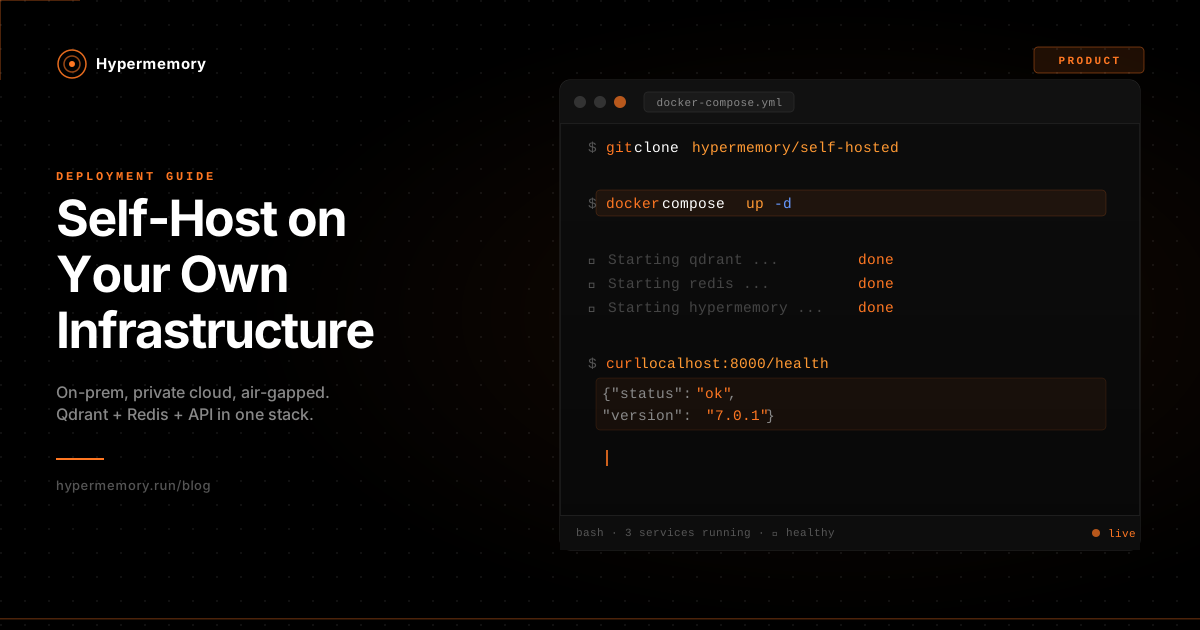
Starting with a single-node deployment: Deploy Qdrant (1 instance), PostgreSQL (1 instance), and Hypermemory service (1 instance). This handles ~100K memories and 50 concurrent queries per second. For production at scale, move to a 3-node Qdrant cluster with replication, RDS PostgreSQL with automatic backups, and a load-balanced Hypermemory service tier. At AI agent production scale — 2 million vectors, 20K queries/day, 50K writes/day — Qdrant self-hosted runs at approximately $96/month fixed cost, compared to $80–160/month for managed cloud options. The economics favor self-hosting well before the 1 million stored facts threshold.
Network isolation is straightforward: Hypermemory and Qdrant communicate over local networks; only the API gateway is exposed. With Kubernetes, this becomes standard network policies. Air-gapped deployments require no outbound connectivity — all models and weights are downloaded during deployment.
One emerging consideration: hybrid retrieval strategies that combine vector search with graph-based navigation. For document-heavy memory stores, graph traversal approaches that follow entity relationships can reduce embedding compute while improving precision on relational queries. Hypermemory's self-hosted architecture supports both vector-primary (standard) and hybrid fusion configurations, with the graph layer available for critical workloads that require relationship traversal. Both Weaviate and Qdrant now ship GPU support, enabling hardware-accelerated indexing for large-scale deployments — a significant shift from 2025 when GPU acceleration required manual integration.
The self-hosting ROI threshold has dropped as tooling matures. A mature engineering team comfortable with VPS deployment can run Qdrant self-hosted at $30–50/month on a small VPS for early-stage workloads, scaling linearly from there. At 100 million vectors, Pinecone can cost 3–5× what self-hosted Qdrant or Milvus costs, with managed services running 1.5–3× more than self-hosted at the 10M-vector scale. The economic decision point in 2026 typically lands at 50–100M vectors or $500+/month in cloud vector DB spend. With Hypermemory's standard deployment patterns, moving to self-hosted takes two weeks of infrastructure setup, not three months.