The AI agent framework landscape in 2026 has consolidated around clear winners. LangChain's LangGraph shipped v1.0 on October 22, 2025, and now leads — LangChain + LangGraph combined log 90 million monthly downloads, with 400+ enterprise deployments at major organizations including Uber, LinkedIn, BlackRock, and JPMorgan. Its graph-based execution model — where nodes are functions and edges are conditional transitions — won the stateful workflow segment. CrewAI sits at 47,800+ stars, executing 10 million agents per month and powering roughly half of Fortune 500 companies. LlamaIndex (47,600+ stars) evolved away from orchestration and is now the dominant choice for the retrieval layer inside agent systems. Microsoft Research released AutoGen 0.4 in January 2025 — a fully reimagined event-driven, async-first architecture — while the community-maintained AG2 fork ships independently (v0.13.2, May 2026).
The problem: each framework has its own memory integration patterns. LangChain expects you to wrap retrievers in custom chains. CrewAI needs memory callbacks injected into agent definitions. LlamaIndex wants you to compose retrievers into its index abstractions. The boilerplate adds up fast, and developers end up writing framework-specific memory integration code instead of focusing on agent logic.
The solution is MCP (Model Context Protocol). Originally introduced by Anthropic in November 2024, MCP has become the de facto standard for connecting LLMs to external systems. OpenAI officially adopted it in March 2025, Microsoft integrated it into Copilot Studio in July 2025, and AWS added support in November 2025. By Q1 2026 the SDK had surpassed 97 million monthly downloads — a ~970× growth in 18 months. The Anthropic MCP registry lists 9,652 servers with 28,959 total version records as of May 2026, alongside over 15,000 MCP-related repositories on GitHub. The protocol itself expanded to five primitives — tools, resources, prompts, sampling, and roots — and added Streamable HTTP as the modern remote transport (with OAuth). 41% of software engineering organizations already run at least one MCP-backed agent in production (Stacklok State of MCP in Software 2026), with security cited as the leading adoption blocker for the remainder. The March 2026 governance milestone made MCP permanent infrastructure: Anthropic transferred full stewardship to the Agentic AI Foundation (AAIF) under the Linux Foundation, with AWS, Anthropic, Block, Bloomberg, Cloudflare, Google, Microsoft, and OpenAI as founding Platinum members — MCP stopped being 'Anthropic's protocol' and became a vendor-neutral industry standard governed by Spec Enhancement Proposals and formal Working Groups. Instead of framework-specific integrations, a single MCP server exposes memory as a set of standardized tools that any framework consumes with zero custom code.
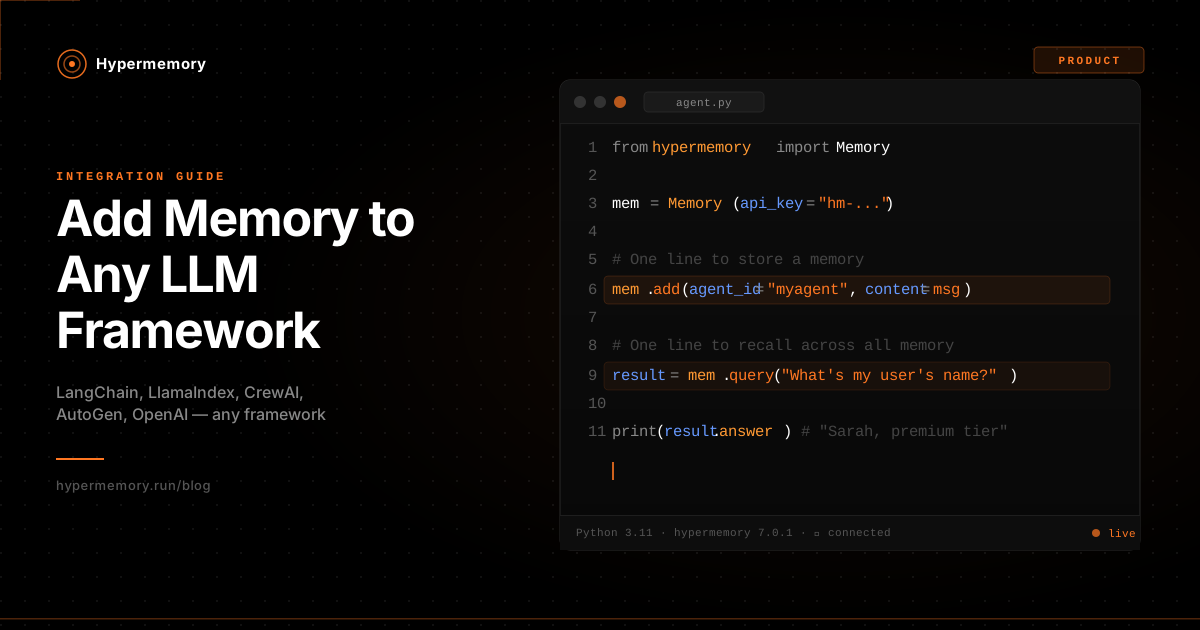
Hypermemory's MCP server implements the memory protocol: `memory.add` to store a fact, `memory.query` to retrieve, `memory.graph` to explore relationships. A LangChain agent adds it like: `agent = create_react_agent(llm, [memory_mcp_tools])`. A CrewAI agent binds it the same way. No framework-specific wrappers. No custom callbacks. One import, instant memory.
The latency is sub-50ms for most queries on memory stores under 100K facts, making it practical for real-time agent interactions. For long-running workflows that span days or weeks, this becomes the difference between agents that learn from past sessions and agents that start over each time.
By adopting MCP as the integration layer, we've turned what used to be a week of framework-specific work into a few lines of code that works across LangChain, CrewAI, LlamaIndex, AG2, and any new framework that implements MCP. That's the power of standards.