Clinical genomics is undergoing a step-change. Whole-genome sequencing (WGS) costs fell below $200 per sample in 2025 — a 5,000× drop since the Human Genome Project — and clinical adoption has followed. The global genomics market reached $29.8 billion in 2025, growing at 15.9% CAGR toward $70.2 billion by 2032. Major academic medical centers now sequence every cancer patient at diagnosis. Population-scale biobanks like the UK Biobank (500,000 participants), All of Us (1 million participants), and FinnGen (500,000 participants) have accumulated petabytes of linked genomic and phenotypic data. AI agents are increasingly central to the pipeline: automated variant callers, LLM-assisted clinical interpretation tools, and multi-agent research systems that correlate novel variants with population databases and published literature in real time. The promise is faster diagnosis, more precise treatment stratification, and prospective risk prediction at population scale. The bottleneck is not compute. It is memory.
A clinical genomics AI agent faces an extraordinary information retrieval challenge. A single whole-exome sequencing (WES) run produces 50,000 to 100,000 candidate variants. A whole-genome run produces 4–5 million. ACMG/AMP classification guidelines require evaluating each clinically relevant variant against population frequency data (gnomAD), curated disease databases (ClinVar, OMIM), functional evidence from in silico predictors and splicing models, segregation data from family members, and published case reports. For a hereditary cancer panel covering 84 genes, an agent might need to cross-reference 200+ variants against 15+ evidence types each — with patient history and prior testing results factored in. The LLM doing this reasoning is stateless by design. It processes a context window and produces output. Between sessions — between runs on the same patient's annual follow-up, between batches in a cohort study — the agent retains nothing. Every variant is re-annotated from scratch. Every literature search is repeated. Every prior reasoning chain is reconstructed from raw inputs. For a genomics institute processing 10,000 samples per year, that adds up to millions of redundant LLM calls and hundreds of thousands of dollars in avoidable compute spend.
The standard workaround is prompt stuffing: loading patient records, prior variant reports, and relevant literature excerpts into the context window before each agent run. It works — until the context fills. A patient with a decade of longitudinal records, three prior variant reports, twelve relevant publications, and five family members' sequencing results easily exceeds 128K tokens. More critically, the most important evidence is often the least recent: a reclassification notice from ClinVar that arrived three months ago, a case report from 2022 that's suddenly relevant because a new variant in the same gene just appeared in the current sample. Prompt stuffing doesn't know what to prioritize; it cannot distinguish a 2026 pathogenicity reclassification from a 2019 preliminary functional study. Summarization destroys the precise HGVS nomenclature and transcript coordinates that clinical interpretation depends on. Single-vector semantic search misses exact keyword matches on specific gene names and variant identifiers — a query for 'BRCA1' might surface conceptually related passages about DNA repair pathways while missing the exact pathogenic c.5266dupC variant in the patient record. None of these approaches solve the fundamental problem: genomics agents need long-term, structured, temporally aware memory that persists across sample runs, patient visits, and live database updates.
The most damaging failure mode is temporal: variant reclassification. ClinVar receives approximately 3,500 new submissions per month, and a significant fraction are reclassifications — variants that were VUS (Variant of Uncertain Significance) when first reported and have now accumulated sufficient evidence to be promoted to Pathogenic or Likely Pathogenic, or downgraded to Benign. The clinical implications are severe: a patient told their PALB2 variant was 'uncertain significance' in 2022 may deserve a revised diagnosis and updated management recommendations in 2026. An agent without temporal memory will either miss the reclassification entirely — searching ClinVar fresh each time, without knowing what changed since the last run — or will surface both the 2022 and 2026 classifications with no reliable way to determine which is current. Hypermemory's temporal supersession engine solves this precisely: when a ClinVar update reclassifies c.1958T>G from VUS to Pathogenic, the new fact supersedes the prior classification in the memory graph. A query for 'What is the current pathogenicity of c.1958T>G?' returns the 2026 Pathogenic verdict. A query for 'When was c.1958T>G first reported as VUS?' traverses the supersession chain to the original 2019 submission. Both answers are available. Neither is confused with the other.
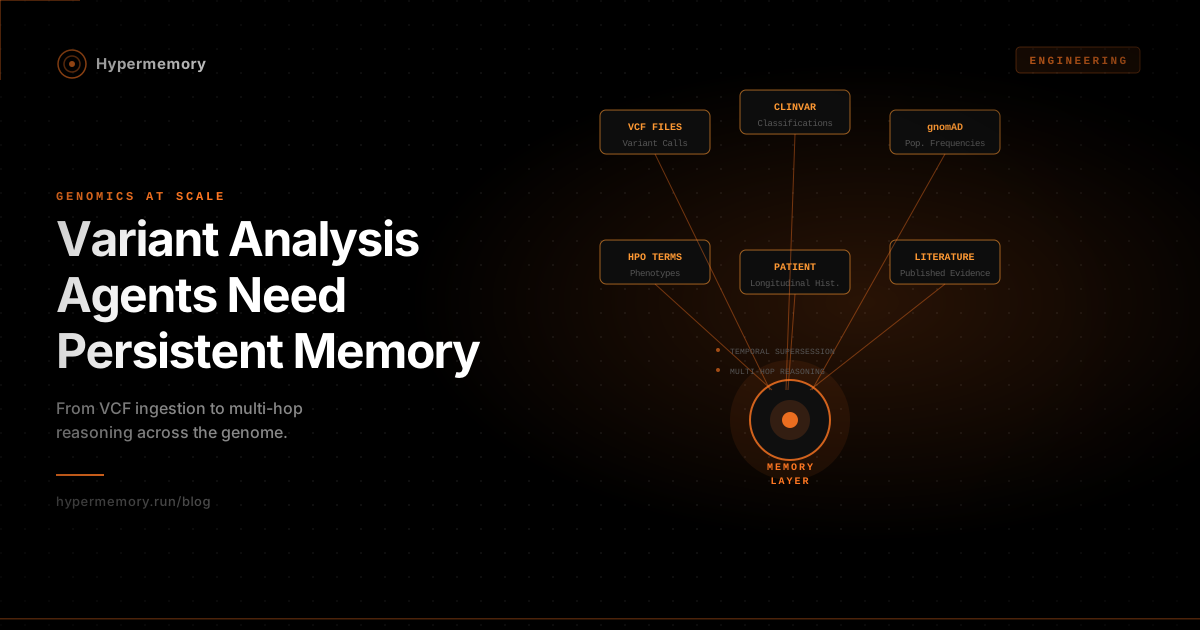
Genomic interpretation is inherently relational, and this is where stateless agents fail most visibly at scale. A variant's clinical significance can only be understood in context: gene → molecular function → biological pathway → disease mechanism → phenotypic presentation → population prevalence. A query like 'Are there other variants in this patient's record that might compound the effect of this VHL mutation?' requires multi-hop reasoning: retrieve the patient's full variant history → filter to VHL-pathway genes (VHL, HIF1A, EGLN1, VEGF) → cross-reference each against the patient's HPO phenotype terms → surface those with plausible compound heterozygosity patterns. No single-step vector search produces this answer. Traditional retrieval architectures require geneticists to run these queries manually, one lookup at a time, typically taking 45 minutes to assemble a complete picture. Hypermemory's multi-hop reasoning engine follows relationship chains across the memory graph — variant → gene → pathway → phenotype → patient record → related variants — returning a complete result set in under 100ms. At the cohort level — 'Find all patients in our breast cancer cohort with PIK3CA mutations and co-occurring ESR1 alterations, stratified by prior endocrine therapy' — this capability becomes the difference between a cohort query that runs overnight and one that runs in seconds.
Hypermemory integrates with genomics pipelines at the data layer. Events ingested to the memory store include: VCF variant calls with per-variant metadata (HGVS notation, gene, transcript, allele frequency, quality scores), structured clinical notes with phenotype terms in HPO format, ClinVar and OMIM fact extracts indexed with classification, evidence strength, and last-updated timestamp, literature summaries extracted by a literature-mining agent and stored as structured facts with citation metadata, and pedigree relationships tracking which family members were sequenced and what their results were. All of this is indexed across Hypermemory's five retrieval strategies in parallel. Semantic search locates conceptually similar variants and phenotypes. BM25 keyword matching retrieves exact variant identifiers, gene symbols, and OMIM accession numbers. Temporal scoring surfaces recent reclassifications and recent high-impact publications with higher weight. Temporal fact search handles 'When was this variant first reported as pathogenic?' directly without an LLM round-trip. Multi-hop graph traversal follows gene-pathway-phenotype-patient chains across the memory graph. The integration is a single MCP server configuration from any agent framework — LangChain, LlamaIndex, CrewAI, or a custom bioinformatics orchestration layer. Call `memory.add(vcf_event)` at the end of each variant annotation step; query with `memory.query('BRCA2 variants with functional evidence in this patient history')` at interpretation time.
The infrastructure cost impact is substantial and measurable. A genomics institute running 10,000 WES samples per year, with 10–30 LLM calls per sample during interpretation, generates 100,000–300,000 LLM calls annually. Without memory, each call re-annotates variants against the same literature and population databases the previous call already processed. With Hypermemory, literature facts, population frequency lookups, and prior patient reasoning chains are stored and reused across runs. For variants seen frequently in the population — common BRCA1/2 founder mutations, high-prevalence ACMG secondary finding variants like LDLR and MYBPC3 variants — the memory hit rate exceeds 80%. That translates directly to a 60–70% reduction in LLM token spend on variant interpretation: at 10,000 samples per year, a six-figure annual reduction in inference cost without any degradation in output quality. Cross-sample reasoning becomes a first-class capability: 'This variant appeared in two prior patients in our cohort; what was the final clinical interpretation, and did it hold up at follow-up?' The memory layer holds that answer without an additional LLM call. Compliance also improves: every interpretation decision is logged in the memory graph with provenance — which facts informed which conclusion, when each fact was added, when prior classifications were superseded. Audit trails that previously required reconstructing reasoning from raw logs are now first-class data structures, queryable by patient, variant, date range, or evidence source.
The genomics AI stack in 2026 is converging on multi-agent architectures: a variant caller, a literature miner, a clinical interpreter, and a patient communication agent operating in coordination. Illumina's Connected Insights platform, Tempus xF liquid biopsy analysis, Foundation Medicine's FoundationOne CDx reporting engine, and Broad Institute's Terra computational platform are all shipping or actively evaluating LLM-driven interpretation layers for high-volume clinical workflows. Without persistent memory, these agents are sophisticated one-shot search engines — fast and accurate on individual queries, blind to history. With Hypermemory, they become learning systems: each sample run improves future interpretations, each ClinVar reclassification propagates automatically across the memory graph, each patient visit builds on longitudinal context accumulated over years. Getting started requires one MCP configuration and a variant ingestion endpoint. The first 100,000 memory operations are free on the Hypermemory developer plan. For regulated environments operating under HIPAA, GDPR, or CAP/CLIA compliance requirements, Hypermemory self-hosted runs entirely within your VPC or on-premises cluster — no genomic data leaves your infrastructure, and the full audit trail remains under your control.