When developers first add memory to an AI agent, they almost always reach for a vector database. The pattern is intuitive: embed the user's message, search for similar past messages, inject the results into the prompt. It works — until it doesn't.
The failure modes are predictable. A user asks 'What was my API rate limit again?' — a keyword-heavy query. Vector search returns semantically similar passages about 'API configuration' but misses the exact number. A user asks 'Did we decide to postpone the launch?' — a temporal query. Vector search returns the original launch discussion from three weeks ago, not the postponement decision made yesterday. A user asks 'Who introduced Alice to the team?' — a relational query. Vector search can't follow entity relationships.
Each of these failure modes has a known solution. Keyword queries → BM25. Temporal queries → recency-weighted scoring. Relational queries → graph traversal. The problem is that you don't know which type of query you'll receive at runtime. The solution is to run all of them.
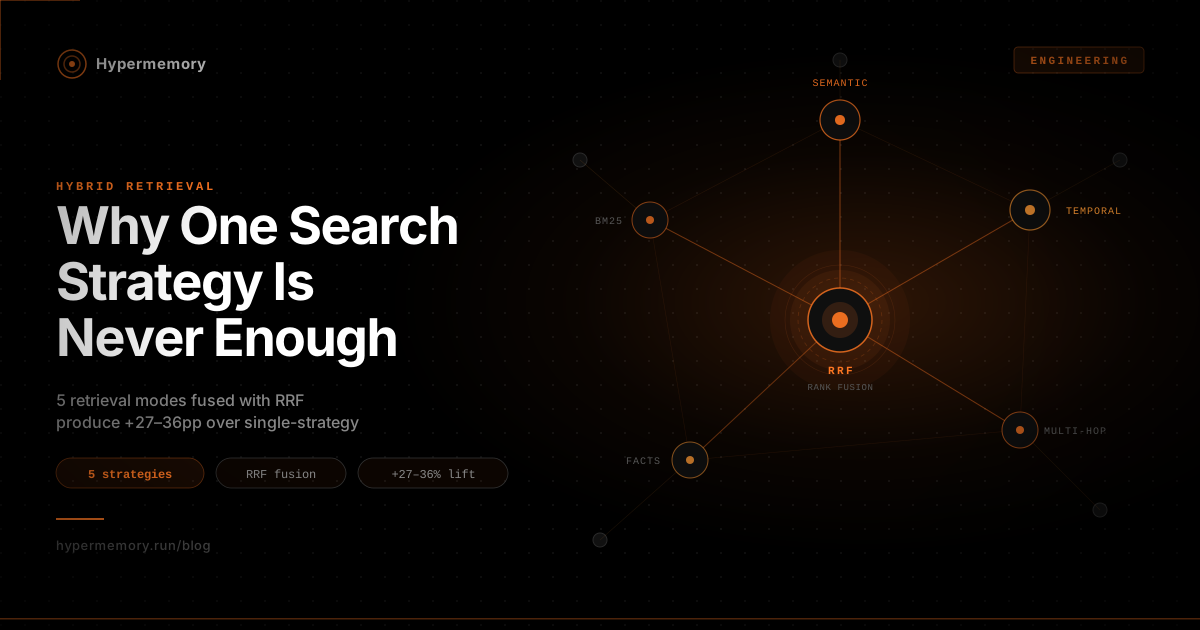
Hypermemory's retrieval pipeline executes five strategies in parallel for every query: Semantic Search (vector embeddings via Qdrant) for conceptual similarity, BM25 keyword ranking for exact term matching, Temporal Scoring that multiplies relevance scores by recency weight to surface recent facts, Temporal Fact Search that extracts and indexes event dates for 'When did X happen?' queries, and Multi-hop Reasoning that follows relationship chains in the memory graph.
The results are fused using Reciprocal Rank Fusion (RRF), a rank aggregation algorithm that combines ordered result lists without requiring score normalization. RRF is particularly well-suited here because the five retrievers produce scores on different scales — cosine similarity, BM25 TF-IDF, and raw recency weights are not directly comparable. RRF sidesteps this by working with ranks, not scores.
Beyond the five core strategies, graph-based retrieval has matured into a sixth pillar. Rather than hoping semantic similarity will surface structurally connected documents, graph traversal explicitly follows entity-to-entity relationships — essential for queries like 'who first mentioned the budget change?' that require tracing provenance chains across memory nodes. Independent benchmarks validate the gap: GraphRAG achieves 3.4× better accuracy than pure vector RAG on knowledge-graph-grounded queries (FalkorDB/Diffbot, 2026), 4× higher recall on cross-document reasoning tasks, and produces 6% fewer hallucinations with 80% fewer tokens on complex multi-document workloads (ACL 2025 FinanceBench paper). The 2026 consensus positions graph traversal as the precision layer for relationship-intensive queries, with the latency trade-off (~2.4× slower than vector-only) justified for multi-hop workloads. A seventh layer is now becoming standard in production: neural reranking. Adding a cross-encoder reranker (such as Cohere Rerank 3.5, the current production model) after the RRF fusion step delivers +23.4% over plain hybrid search and +30.8% over BM25-only retrieval on financial domain benchmarks. Reranking adds only a few milliseconds of latency, well within the margin of LLM inference times. A noteworthy 2026 finding from a comprehensive financial QA benchmark (arXiv:2604.01733): BM25 outperforms dense retrieval on most exact-match metrics even against text-embedding-3-large, one of the strongest commercial embedding models available — a counterintuitive result that reinforces why multi-strategy fusion is necessary rather than optional. The emerging production best practice is a two-stage pipeline — retrieve top-1,000 with hybrid search, rerank top-100 with a cross-encoder — which fits well within p99 latency budgets for interactive agents and has become the recommended minimum viable baseline for any RAG deployment in 2026.
The numbers validate the architecture. By Q1 2026, 67% of Fortune 500 companies had deployed at least one RAG solution in production — up from 23% in 2024. More telling: enterprise intent to adopt hybrid retrieval tripled in a single quarter (Q1 2026), from 10.3% to 33.3% of teams, as organizations that scaled out pure dense retrieval hit the 'scale wall' on complex, multi-hop agent queries (VentureBeat VB Pulse, April 2026). On the LoCoMo benchmark specifically, single-strategy retrieval baselines score 52–67% depending on the domain — Hypermemory's fusion approach scores 87–94% across all five domains. That 27–36 percentage point gap is the difference between a memory system that works in demos and one that holds up in production. Qdrant benchmarks show 6ms p50 latency for hybrid search, with recall boosted by 17% over dense-only search — confirming that the latency overhead of multi-strategy retrieval remains negligible at agent inference timescales.
A common concern is latency overhead. Running two retrievers in parallel adds roughly 6ms to p50 latency versus dense-only search — noise against LLM inference times of 500ms to 2 seconds. The implementation is straightforward: each retrieval strategy runs as an async function; results are merged with RRF; the top-k merged results are returned to the agent. On average Hypermemory returns results in under 50ms for collections under 100K memories.