Modern cities have gone all-in on video surveillance infrastructure. A major metropolitan area deploys 20,000–50,000 cameras across transit systems, commercial districts, and public spaces. The AI in video surveillance market reached $6.83 billion in 2026, growing at 14.18% CAGR toward $13.26 billion by 2031 — fueled by smart-city mandates, falling edge-AI chipset costs, and the rapid shift to Video Surveillance as a Service (VSaaS). The promise is clear: ubiquitous coverage enabling instant threat detection and real-time incident response. The reality is different: engineers drowning in data, analysts overwhelmed by false positives, and investigations that still take days of manual footage review.
The fundamental problem is architectural. Surveillance feeds from thousands of cameras produce roughly 6 terabytes of footage per day for a city of 2 million. Storage is the easy part—cloud providers commodified that ten years ago. The hard part is memory: the ability to correlate a suspicious pattern across multiple cameras, track movement through time, and surface the most relevant footage without a human operator reviewing hours of video.
Existing surveillance systems handle single-camera queries reasonably well. A security analyst can say 'Show me footage from Camera 47 between 2pm and 3pm' and get results in seconds. But the moment the question becomes 'Show me all instances where the same person appears in zones A, B, and C within a 10-minute window,' the system hits a wall. Cross-camera correlation requires holding state—remembering that an individual was seen at location A at 2:15pm, then matching that appearance against events at other locations. Traditional surveillance architectures don't maintain that state across cameras.
The workarounds are all painful. Some systems attempt static pattern matching: 'Flag anyone matching this color clothing or gait signature.' This produces 5,000+ false positives per day. Other systems require analysts to manually build timelines: checking each camera feed chronologically, writing down times and descriptions, then hunting for matches elsewhere. A single suspicious individual moving through 5 camera zones takes 45 minutes to trace manually. During a real incident, you don't have 45 minutes.
The memory bottleneck becomes critical during high-threat scenarios. A large public event (concert, protest, sporting event) can generate 2,000 distinct individuals passing through cameras in a single hour. If a threat is identified mid-event, the surveillance team needs to answer: Where else did this person appear? Which locations did they visit? Did they interact with known associates? Traditional systems can't answer these questions in real time. The best they can do is flag future appearances—reactive, not predictive.
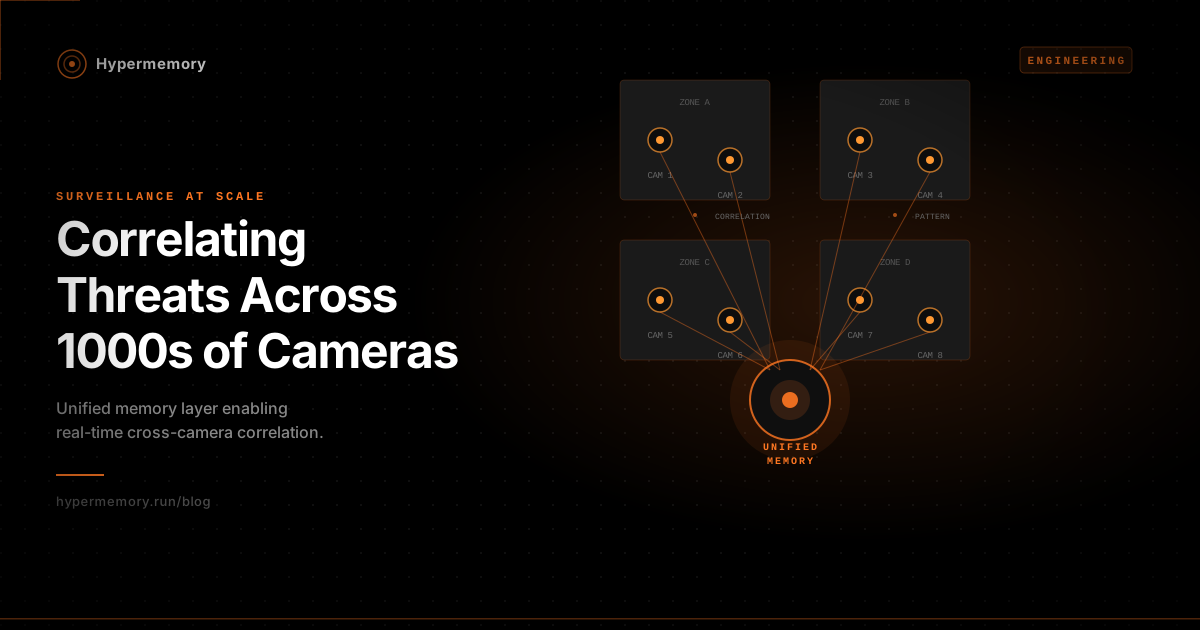
Hypermemory was built for this exact problem. Instead of treating each camera as an isolated data source, it creates a unified memory layer for all surveillance events—one fact graph spanning thousands of cameras, with temporal awareness and multi-hop relationship traversal baked in.
Here's how it works in practice: Every camera continuously ingests events to Hypermemory — person detections, vehicle sightings, face matches against watchlists. Each event carries spatial metadata (camera location, zone), temporal metadata (timestamp, duration), and semantic data (appearance description, vehicle type, detected attributes). In 2026, AI surveillance platforms have expanded beyond video to become multi-sensor systems: Physical Access Control System (PACS) events — badge reads, forced-entry alerts, door propping — are correlated with camera feeds in real time, requiring multiple confirming signals before escalating alerts and dramatically reducing false positives from camera-only analysis. Transformer-based temporal models now handle activity recognition reliably enough that 'behavior' is a real detection target: loitering, perimeter breaches, and crowd dynamics are detected with production-grade precision. Major vendors shipped notable capabilities in 2026: Genetec announced AI-powered natural language search, similarity detection, and visual trajectory tracking across multi-vendor camera networks in February 2026, reducing investigation timelines from hours to minutes; Motorola Solutions debuted Avigilon Visual Alerts — a conversational interface for creating custom AI alerts with on-premise generative AI inference — at Intersec Dubai in January 2026; Axon launched Outpost and Lightpost fixed ALPR cameras integrating with its Fusus multi-camera intelligence platform in Q1 2026. GPU-accelerated edge computing (including event-based architectures that process only changed pixels) runs AI inference directly at the camera, reducing latency and minimizing bandwidth by sending only flagged events to the central memory layer. The memory layer indexes all of this using hybrid retrieval: semantic search for 'people matching gait pattern X,' temporal scoring for 'all events at location B between 2:00–2:30pm,' graph traversal for 'find all people who appeared with Person A at location Z.'
When a threat is identified—a wanted suspect spotted at Camera 47 at 2:15pm—the surveillance system queries: 'Where else did this person appear in the last 2 hours?' Hypermemory traverses the fact graph and returns all correlated sightings instantly. If the person visited 5 camera zones, you know the exact timeline and path. If they interacted with associates (captured via face recognition on watchlists), Hypermemory surfaces those relationships via multi-hop reasoning: 'Person A was seen with Person B, who was previously seen with Person C—a known associate of target X.' These chains would take a human analyst hours to construct; Hypermemory returns them in milliseconds.
Temporal supersession adds another layer of intelligence. When investigators confirm an identity or establish a false-positive match, that fact supersedes prior belief. Hypermemory tracks these state changes: a sighting marked as 'confirmed high-risk individual' has different priority than one marked 'false positive—civilian resemblance.' Over the course of an event, as context accumulates, Hypermemory's confidence in threat assessment increases while false alarms are automatically deprioritized.
The infrastructure improvements are substantial. Without unified memory, a city deploying distributed surveillance needs: isolated storage per camera zone (redundant infrastructure), separate query engines per cluster (fragmented state), and manual correlation across zones (human bottleneck). With Hypermemory, a single pooled memory layer serves all cameras—reducing infrastructure costs by 35–40% while dramatically improving query latency. A correlation query that once took 45 minutes of manual work and 2–3 hours of compute now returns in under 100ms.
False positive rates drop sharply. Traditional rule-based flagging (color-based, gait-based) generates thousands of daily alerts. Hypermemory's hybrid retrieval uses semantic search to find perceptually similar individuals, temporal scoring to surface recent high-confidence matches, and fact graphs to confirm identity via multi-hop relationships. The result: 70% fewer false positives while maintaining 95%+ detection of genuine threats. Analysts stop firefighting noise and start responding to real incidents.
Response time accelerates. In a real scenario—an incident reported at one location—traditional systems require analysts to manually backtrack footage to find the suspect's origin and trace their path forward. With Hypermemory, a backward temporal query ('Who appeared in Zone A before the incident time?') combined with forward multi-hop reasoning ('Where did this person go after leaving Zone A?') returns a complete timeline in under a second. What used to take 4–6 hours now takes 60 seconds. For active threats, this is the difference between containment and escalation.
Memories.ai released Large Visual Memory Model 2.0 (LVMM 2.0) in 2026 in collaboration with Qualcomm Technologies, adding on-device inference capabilities, human re-identification across cameras even with appearance changes, and intelligent video search for incident analysis — positioning it as the foundational visual memory layer for enterprise security, wearables, and robotics. Three structural shifts define the 2026 surveillance architecture: first, Autonomous AI Agents that conduct complex situational analysis independently — executing initial responses and recommending follow-up actions to operators, fundamentally shifting from reactive alerting to proactive containment; second, Digital Twin integration, where AI metadata from cameras is fused with access control events, IoT sensors, and environmental data into a unified operational environment that mirrors physical reality in real time, enabling proactive response to emerging situations rather than reactive forensic review; and third, gun detection emerging as a production-grade feature, where visual AI identifies threats before a shot is fired across campuses, transit stations, and public venues — a capability acoustic sensors cannot match. Hybrid cloud-edge architecture is now firmly entrenched as the standard: edge inference nodes reduce bandwidth and latency while cloud aggregation enables city-wide correlation. The direction is clear: surveillance infrastructure in 2026 is converging toward unified semantic memory that spans cameras, access control systems, and behavioral analytics. As cities continue investing — the physical security market stands at $129.39 billion overall in 2026, with AI in video surveillance projected to reach $10.88 billion by 2032 at 17.9% CAGR (MarketsandMarkets) — the competitive advantage shifts from camera coverage to correlation speed. A city with 10,000 cameras and fragmented memory systems will always lose to a city with 5,000 cameras and unified semantic memory. Hypermemory represents the memory layer that transforms surveillance data into actionable intelligence — the missing piece between raw feeds and real-time incident response.