Every production AI deployment eventually hits the same wall: an agent that reasons brilliantly in the moment but forgets everything the second a session ends. Users repeat themselves. Agents lose track of preferences. Long-running workflows collapse because the agent can't remember what it agreed to three conversations ago.
The root cause is architectural. Large language models are stateless by design — they process a context window and produce output, with no persistence between calls. The standard workarounds (stuffing conversation history into the prompt, summarizing older turns, or relying on a single vector search) each break down in predictable ways.
Prompt stuffing hits token limits. At 128K tokens, even GPT-4 Turbo can hold roughly 200 pages of text — enough for a single long session, not weeks of ongoing agent operation. Summarization loses precision. When you compress 50 messages into a paragraph, the specific facts — dates, numbers, commitments — are the first casualties. Single-vector search misses context. Semantic similarity finds passages that 'feel' related, but fails on exact keyword matches, temporal queries ('what did we decide last Tuesday?'), and multi-hop reasoning ('who introduced Alice to Bob?').
In 2026, memory has emerged as a first-class architectural component with its own benchmarks, research literature, and measurable performance gaps between approaches. The agentic AI memory market reached $6.49 billion in 2025 and is projected to grow to $33.54 billion by 2030 at a CAGR of 38.9%. The competitive landscape reflects this shift: three dominant orchestration frameworks — LangChain's LangGraph (which shipped v1.0 on October 22, 2025, with LangChain + LangGraph combined now logging 90 million monthly downloads and 400+ enterprise deployments at Uber, LinkedIn, BlackRock, and JPMorgan), CrewAI (47,800+ stars, executing 10 million agents per month), and LlamaIndex (47,600+ stars) — have each staked out distinct architectural territory. LangGraph won the stateful workflow segment; CrewAI took the accessible multi-agent middle ground; LlamaIndex evolved into the dominant retrieval layer. Microsoft Research released AutoGen 0.4 in January 2025 with a fully reimagined event-driven, async-first architecture; the community-maintained AG2 fork ships actively, reaching v0.13.2 in May 2026. On the memory-specific side, Mem0 (51,000+ GitHub stars, $24M raised, 100,000+ developers) delivers a hybrid vector + graph + key-value store with an April 2026 token-efficient algorithm averaging under 7,000 tokens per retrieval call; Letta (formerly MemGPT, $10M seed) takes an OS-inspired three-tier memory approach with a memory-first coding agent launched in March 2026; and EverOS (EverMind) positions itself as a 'Long-Term Memory OS,' claiming 93.05% on LoCoMo. Beyond managed products, the LangChain team launched LangMem, an SDK that simultaneously manages three memory types: episodic (past interactions), semantic (extracted facts), and procedural — where agents can rewrite their own system prompts based on accumulated feedback. Cloudflare launched Agent Memory in April 2026 private beta — a managed service with five-channel parallel retrieval (semantic, keyword, HyDE vector, exact fact-key, and raw message search) fused with RRF, extracting structured facts without bloating the context window. The most architecturally significant memory development of Q2 2026 arrived on May 6 when Anthropic launched 'Dreaming' at Code with Claude as a research preview: a scheduled background process that reviews past agent sessions and rewrites the memory store — removing duplicates, replacing stale entries, and surfacing newly discovered patterns — so agents self-improve between sessions without manual curation. Legal AI company Harvey reported roughly 6× task completion rate improvements after deploying Dreaming. The emerging killer feature across 2026 deployments is team-scale shared memory — hierarchical profiles organized at individual, team, and organization levels so conventions learned by one agent propagate immediately across an entire fleet.
Enterprise AI is converging on the same realization: 80% of enterprise applications shipped in Q1 2026 embed at least one AI agent, up from 33% in 2024. LinkedIn's production Cognitive Memory Agent (CMA) — detailed in an April 2026 InfoQ report — is an instructive example: a generative AI infrastructure layer providing persistent memory across episodic, semantic, and procedural layers via streaming and batch pipelines, supporting multi-agent coordination at LinkedIn scale. The hard problem they solved, and the one every production team hits, is not storing memories but managing writes: the AUDN loop (Add, Update, Delete, None) evaluates every incoming memory against the existing store before writing, resolving contradictions before they accumulate. A Mem0 production study of 50,000 real-world sessions quantifies exactly what happens without this curation: benchmark accuracy collapsed from 91.6% to 49% after 30 days of live usage as entity contradictions and stale facts accumulated — the gap between demo performance and production reliability.
Hypermemory was built to solve this at the architecture level. Instead of patching the context window, it operates as a persistent memory layer outside the LLM — storing facts, relationships, and events in a structured graph that survives session boundaries.
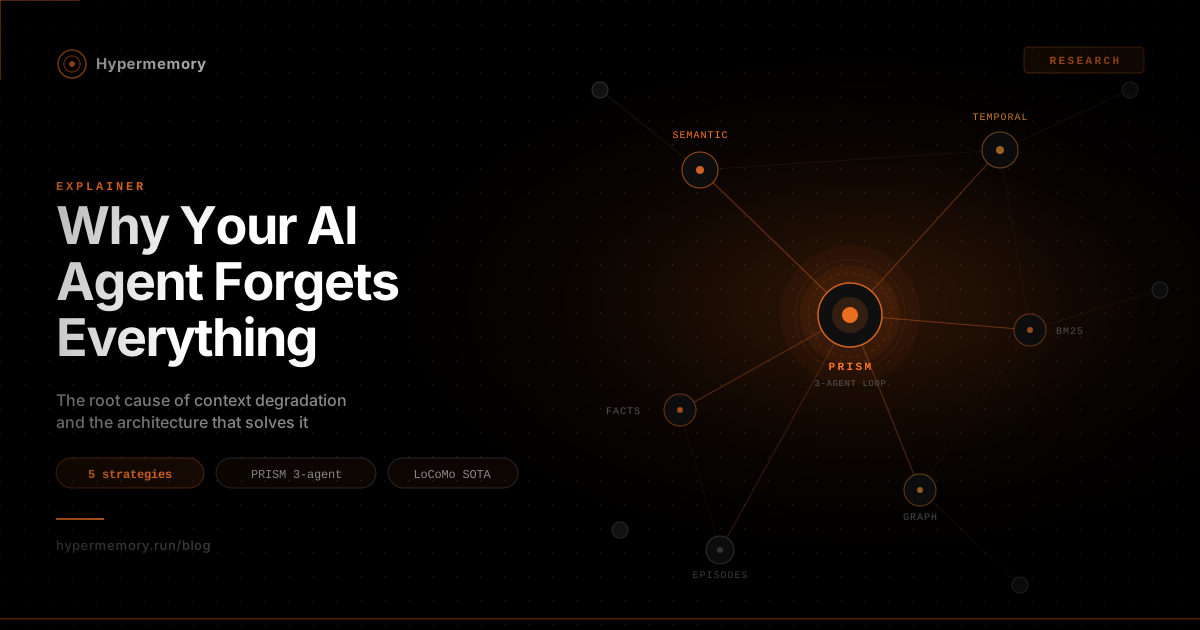
The retrieval engine combines five strategies: semantic search via vector embeddings (Qdrant), BM25 keyword ranking, temporal scoring that weights recent memories higher, date-aware fact retrieval for 'When did X happen?' queries, and multi-hop reasoning that follows relationship chains across the memory graph. These are fused using Reciprocal Rank Fusion (RRF), which consistently outperforms any single retrieval strategy on the LoCoMo benchmark.
The result: agents that remember what users told them weeks ago, track which facts have changed over time, and answer complex temporal questions without hallucinating. On LoCoMo — the standard benchmark for conversational memory — Hypermemory achieves 92% on Temporal Reasoning and 94% on Single Hop question answering, compared to 61% and 67% for baseline retrieval systems.
Getting started takes one import. Hypermemory exposes a REST API and MCP (Model Context Protocol) integration that works with LangChain, LlamaIndex, CrewAI, AG2, and raw OpenAI or Anthropic clients. With native MCP support now standard across agent frameworks in 2026 — 97 million monthly SDK downloads, 41% of software engineering organizations running MCP-backed agents in production (Stacklok, 2026), and over 15,000 MCP-related repositories on GitHub — integration has never been simpler.